

Preparing for a job interview in Switzerland, whether for your first role or your next career step, can feel overwhelming.
JIP (Job Interview Practice) is an AI-based interview preparation tool that helps you practice with real job scenarios and structured feedback.
Many candidates realize that interviews require demonstrating knowledge and explaining their experience clearly, logically, and with relevant examples. Even when they have the right skills, it can be challenging to present them convincingly under pressure. Answers may feel too general, not structured enough, or disconnected from the role requirements.
JIP provides a practical way to prepare for interviews by using AI simulations based on real job postings. Instead of guessing what employers might ask, candidates can practice responding to relevant questions and receive feedback on clarity, structure, and confidence.
Research shows that structured interview practice can improve interviewees’ performance by around 15–30% and reduce anxiety by 40%. JIP provides exactly that: AI-powered simulations based on real job postings, with feedback on clarity, structure, and confidence.
Understanding what interviewers are looking for
Interviewers in Switzerland focus on relevance and clarity. They want to understand how you think, how you make decisions, and how your experience connects to your role. Interviews are typically formal and focused rather than casual. You should present your experience in a structured and relevant way, connect it to the job requirements, and support your answers with concrete examples.
Follow-up questions are very common. An interviewer might ask you to expand on a detail, explain your reasoning, or clarify how you measured success. This is not meant to challenge you but to understand how you approach your work in real situations.
JIP reflects this structure from the beginning. Even before starting a session, it guides you, using AI, toward what matters most: your motivation, your relevant experience, and how well you understand the company and the role.
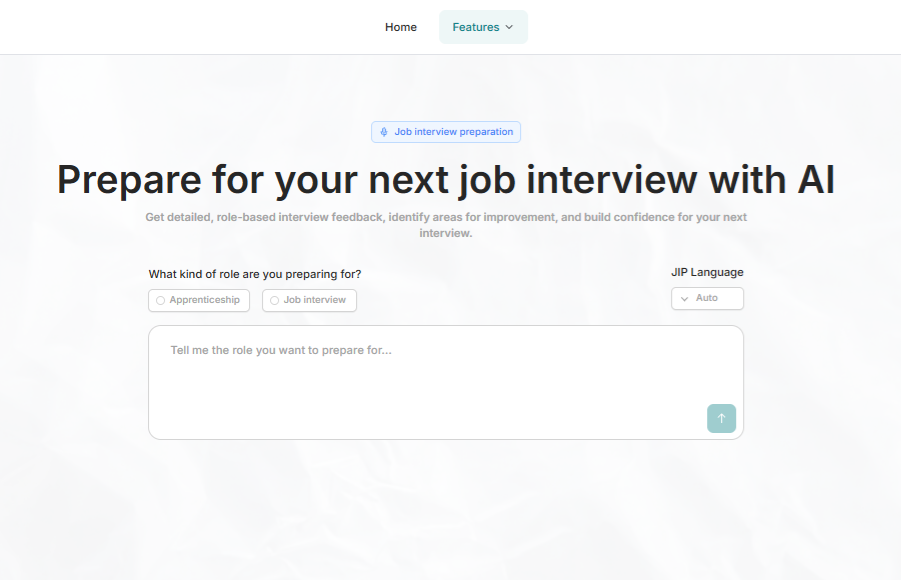
JIP uses AI to generate interview scenarios tailored to your target role.
Questions to be prepared for
Behavioural and pre-screen questions
Many interviews start with questions that explore your motivation and how your experience connects to the role. These questions may sound simple, but they require structured and thoughtful answers.
Typical questions during an interview:
- Tell me about a project where you collaborated with different teams.
- How does your previous experience prepare you for this role?
- Why are you interested in this position?
- Describe a situation where you had to adapt your approach.
This is something JIP simulates very effectively. If your answer stays too general, it guides you deeper. You may be asked to be more specific and clarify how your experience actually applies to the role. You are encouraged to expand your response, explain your thinking, and provide concrete examples. It is as if the interviewer is coaching you in real time.
For example, instead of stopping at a general statement, you are pushed to:
- Explain how the project started and what your role was
- Describe the steps you took
- Highlight decisions you made along the way
- Connect the outcome back to the role you’re applying for
This turns simple questions into structured conversations, which reflects how real interviews often unfold.
Role-specific and technical questions
Once the interviewer understands your background, the focus usually shifts toward how you apply your skills in practice.
During the interview, you will encounter questions like:
- How do you approach solving a problem in your work?
- Which tools or methods do you use to complete your tasks?
- Can you walk me through how you handled a recent task or project?
- How do you decide what to prioritize when managing multiple responsibilities?
Depending on the role, you will be asked about specific tools, real challenges, and hands-on scenarios relevant to the position. The expectation is not just to name them, but to show how you actually work with them. JIP pushes you beyond surface-level answers. If your answer lacks depth, follow-up prompts guide you toward a more complete explanation.
Even short, unclear answers can trigger suggestions like:
- Walk through your process step by step
- Mention specific tools or methods
- Explain how you approached a problem
- Connect your actions to measurable outcomes
This is particularly valuable because many candidates understand the concepts but struggle to explain how they apply them in practice. JIP doesn’t let the answer stop too early. It keeps pushing for clarity and depth, which mirrors the kind of probing questions you would face in an actual interview.
How the review session improves your interview performance
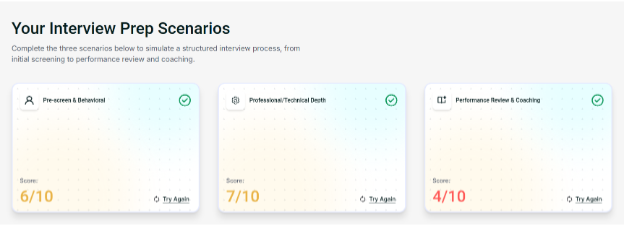
Answering questions is only one part of preparation. Understanding how to improve them is just as important. After each session, JIP provides targeted feedback based on your responses. Instead of general comments, it highlights where your answers can go further and how to strengthen them.
What stands out is how precise and relevant the feedback feels. It reflects how an experienced interviewer would evaluate your answer and how effectively you communicate it. Each session includes a performance score from 1 to 10, along with targeted feedback across different scenarios, making your progress visible over time.
Why preparation matters (especially for career changers)
If it’s been a while since you’ve been through the job application process, job interviews can feel even more daunting. Expectations may have changed, and it might take a while to get used to how detailed and specific your answers need to be.
For career changers, the challenge is even greater. You’re not just answering questions—you’re repositioning your entire professional background.
Interviewers often try to understand how your experience relates to your new career path. They want to see how your skills apply, how you think, and how quickly you can adapt. Without preparation, it’s easy to fall back on vague explanations or focus too much on what you lack rather than on what you bring to the table.
Practicing realistic scenarios allows you to shift your perspective. You’ll start to frame your experiences more strategically, highlight relevant skills, and demonstrate how your background supports your next career move.
Conclusion: what good preparation actually looks like
Good preparation is not about memorizing answers. It is about becoming comfortable communicating your experience with confidence and purpose. When you practice with realistic scenarios, you begin to recognize patterns in questions, improve how you structure your answers, and respond more confidently to follow-up questions.
JIP guides you through the preparation process and keeps pushing your answers further. It doesn’t let you stop at a basic response. It challenges you to explain your thinking, expand your examples, and refine how you present your experience.
Each session builds on the previous one, so your progress becomes visible in what you say and how you handle the conversation.
If you want to feel more prepared, more confident, and more in control during your next interview, the best way to get there is to practice it.