

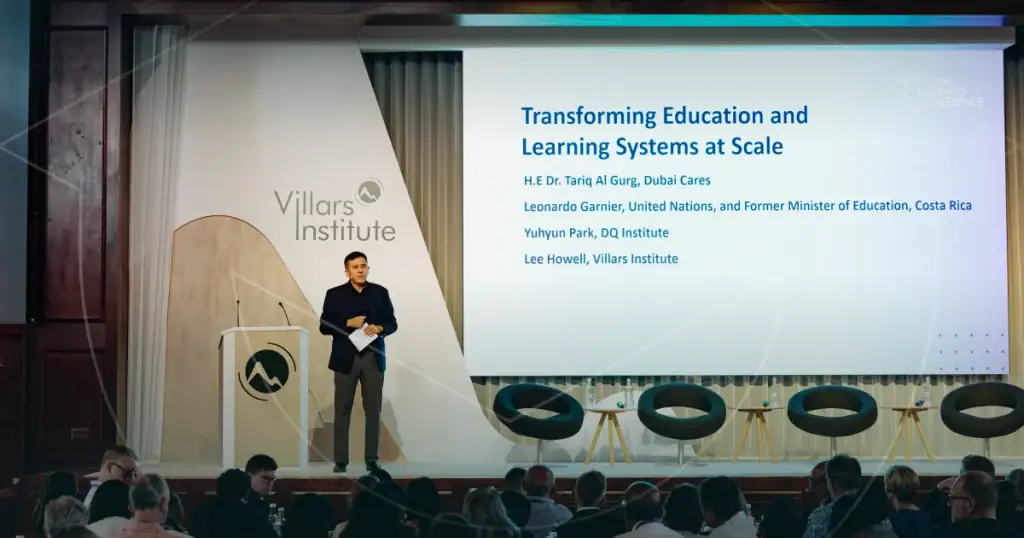
This year’s Global Learning Conference, hosted by the Villars Institute, brought together visionaries, technologists, policymakers, and education leaders from around the world. Set against the stunning backdrop of the Swiss Alps, the event served as both a reflection point and a launchpad for redefining what learning should look like in a rapidly evolving global society.
Learniverse was honored to be part of this pivotal gathering. Our CEO, Marco Real, joined the high-level panel discussion “10 Learning Frontiers: E-Learning Platforms,” contributing to an open dialogue on how we can co-create digital ecosystems that are scalable, inclusive, and deeply human.
Here are our key takeaways from two days of transformative exchange:
Rethinking the Role of Teachers
The world faces a growing teacher shortage, and 44 million new teachers will be needed by 2030. This statistic sparked a vital conversation: the role of the teacher must evolve.
Teachers are no longer just knowledge transmitters; they’re becoming mentors, guides, and emotional anchors in the learning journey. To retain and empower them, systems must invest in continuous, co-created professional development that reflects real classroom needs.
At Learniverse, we believe that technology should never replace teachers; it should support them. AI can’t offer empathy or cultural understanding, but it can free up time, simplify admin, and allow teachers to focus on what they do best: teaching humans.
AI: A Partner, Not a Replacement
One theme stood out clearly: AI is a catalyst, not a substitute. From personalized learning to automated grading, AI offers unprecedented efficiency, but the goal isn’t to mechanize education; it’s to humanize it.
By offloading repetitive tasks, AI gives teachers back the time to engage more deeply with their students. Platforms like Learniverse are already integrating AI to create adaptive learning paths, support multilingual classrooms, and provide instant feedback, without removing the teacher from the equation.
In large classrooms where personalization is tough, AI becomes the invisible assistant, helping ensure every learner gets what they need.
Closing the Global Digital Divide
As powerful as digital education is, it remains out of reach for millions. In many regions, infrastructure barriers, lack of electricity, devices, or reliable internet, undermine access. Moreover, much of the content available is designed from a Western lens, often failing to reflect the needs and cultures of learners in the Global South.
If we’re serious about educational equity, then access, localization, and infrastructure must be part of every innovation roadmap.
That’s why Learniverse is being built for low-bandwidth, multilingual, and offline-capable environments, because the future of learning must be inclusive by design, not by extension.
Fostering Critical Thinking in the Age of AI
With AI-generated content becoming more accessible, learners need new skills, not just to consume but to critique. Media literacy, source evaluation, and independent thinking are now essential for navigating the digital world.
Education systems must resist the temptation to replace complexity with convenience. Mistakes, exploration, and problem-solving must remain central to how we learn.
Curriculum for a New Era
“What should young people learn?” This was one of the conference’s most provocative questions.
The answer? A radical rethinking of curriculum. Tomorrow’s learners need more than memorization: they need creativity, emotional intelligence, collaboration, and digital fluency. Interdisciplinary, project-based models are emerging as key vehicles for relevance in an uncertain world.
Education Is a Right, Not a Privilege
The message was clear: education must be treated as a human right, not a luxury. In times of crisis, whether economic, political, or environmental, education is often among the first systems to suffer. To build long-term resilience, governments must invest in accessible, inclusive, and crisis-proof learning infrastructures. This includes supporting educators, expanding access, and making digital learning equitable, not just available.